
FOR BUILDERS.
NOT BROWSERS.
THIS IS GHOST NODES — UNDER THE HOOD
What used to take days in traditional integration platforms now takes minutes
Ghost Nodes is not a dashboard.
It’s not a low-code toy.
And it’s definitely not another rule engine in disguise.
Ghost Nodes is a distributed integration runtime for automating workflows between systems.
An execution architecture — where the coordination layer between your systems makes them behave like one.
Legacy. Cloud. Hybrid.
ERP, APIs, file and event streams.
Ghost Nodes doesn’t glue systems together.
It orchestrates them.
WHAT YOU ARE ACTUALLY BUILDNING
Ghost Nodes is where integrations stop being chores and start becoming leverage.
This is where you build how your business actually runs.
Not the UI.
The engine underneath it.
THE BUILDING BLOCKS
FROM DAYS TO MINUTES
What used to take days now takes minutes.
Because you’re composing flows — not writing glue code.
VISUAL BY DEFAULT
Build integrations by dragging and snapping parts together.
Save code for when you truly need it.
ONE FLOW. ONE TRUTH.
No silos. No black boxes.
Just clean, predictable behavior across your stack.
PROOF, NOT PROMISES
A quick look under the hood before we go deep.
BUILT TO RUN. NOT TO DEMO.

A central runtime orchestrates distributed agents and executes each flow independently — because real systems fail in parallel, not in sequence.
APIs IN. CHAOS OUT.
External APIs are wrapped into adapters so flows stay clean, predictable, and blissfully unaware of vendor weirdness.


COMPOSE. DON’T GLUE.

Flows are built as graphs — dragged, tested, versioned, and deployed — not written as brittle glue code at 2 AM.
ONE PLACE TO BUILD. INFINITE PLACES TO RUN.
Design, deploy, and monitor integrations in real time — without hunting logs across five different tools.

CONNECT FIRST. CUSTOMIZE LATER.

A growing adapter library connects hundreds of systems out of the box — and still lets you drop down to code when you actually need to.
GHOST ARCHITECTURE FOUNDATIONS
The underlying execution model of Ghost Nodes.
Where logic lives.
How it moves across systems.
And why it doesn’t collapse when reality does.
GHOST KEY COMPONENTS
Each has a clearly defined responsibility — and none of them tries to do everything.
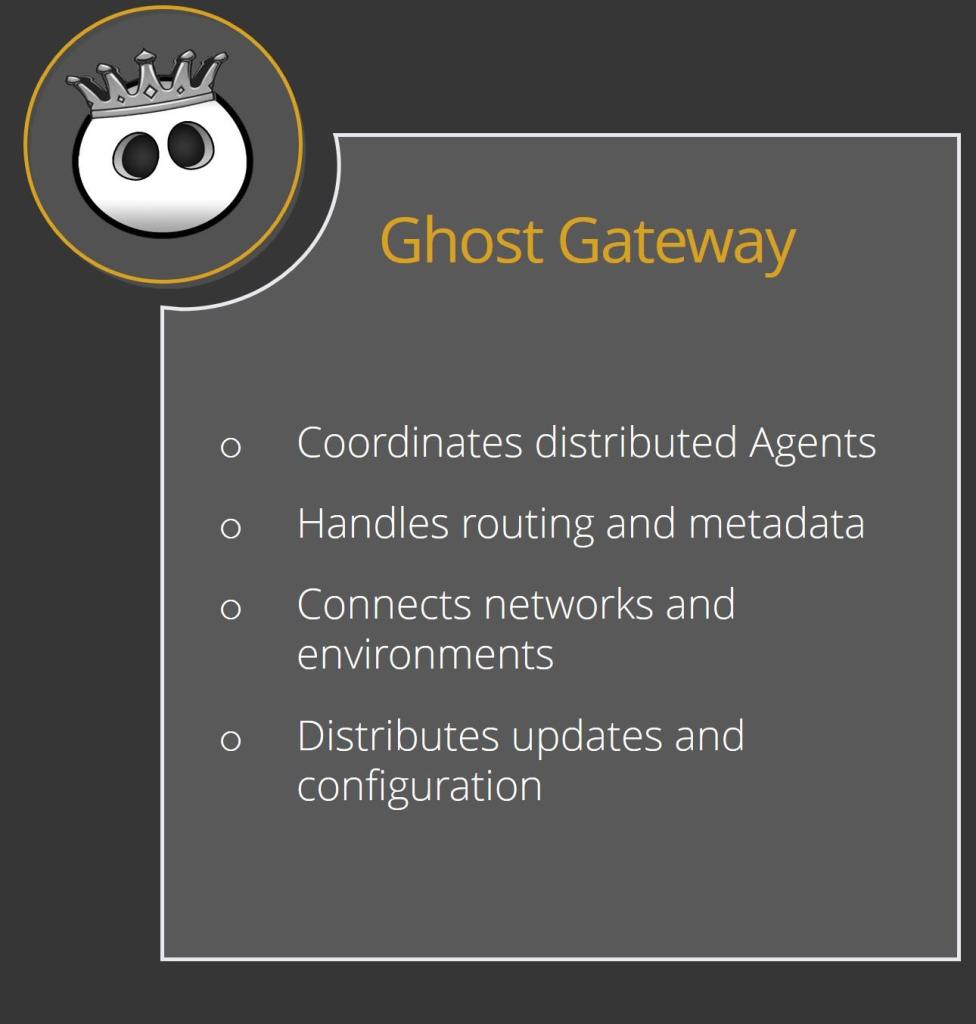
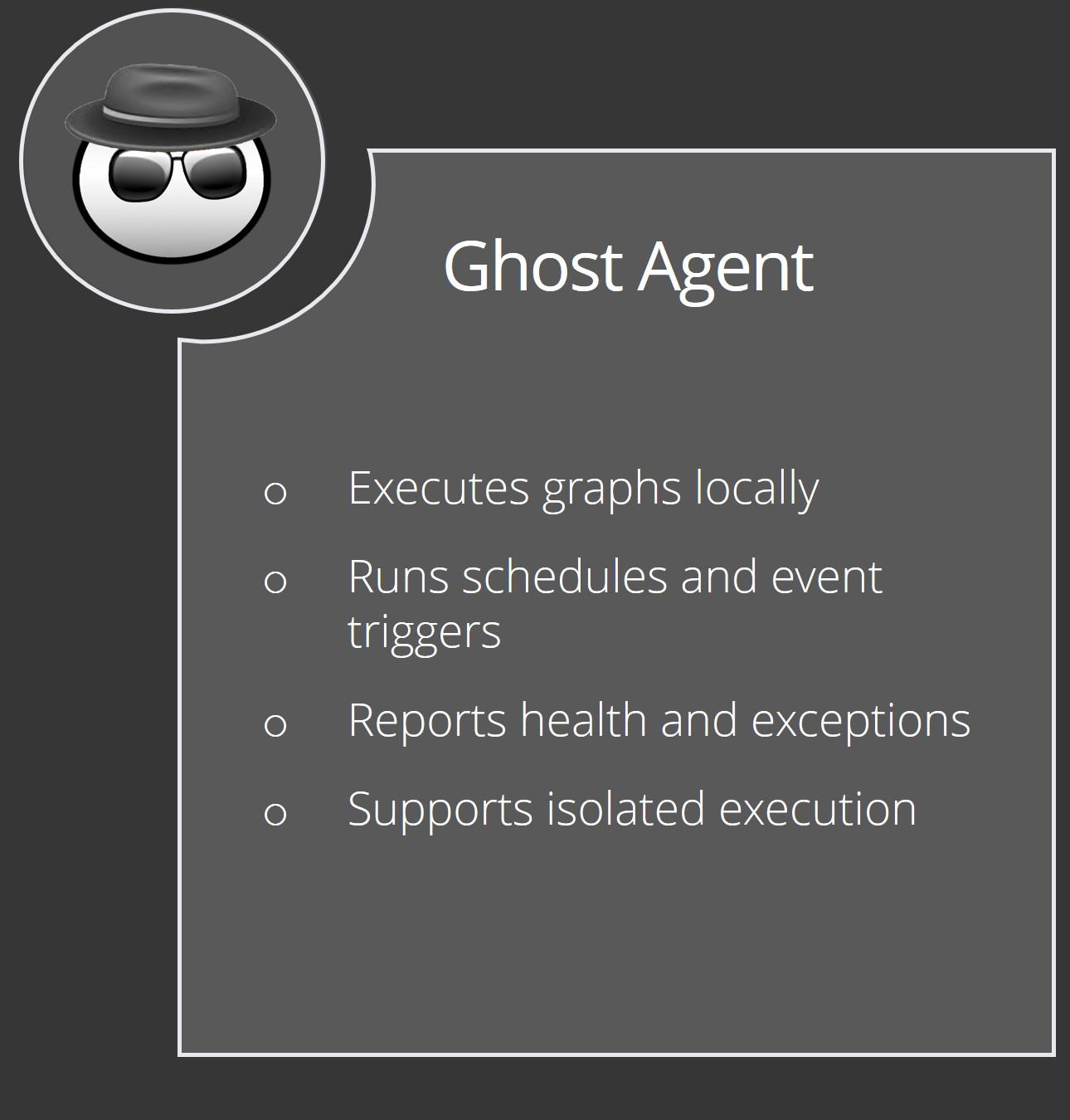
Ghost Agents are execution processes — not AI agents.
SYSTEM LANDSCAPE
How Ghost Nodes spans real-world system boundaries.
Corporate networks, customer environments, cloud platforms and external APIs each run logic locally — through Ghost Agents deployed where systems actually live.
Gateways provide secure connectivity across boundaries, zones and networks.
A coordinating runtime exists — but execution itself remains fully distributed.

No monolithic hub.
No shared global queue.
No single point of failure.
DEEP DIVE MENU
This is where Ghost Nodes is explained in depth.
Pick your angle. Then go deep.
Architecture & Runtime
(Ghost Nodes in real systems)
Central orchestration. Distributed execution.
Agents, gateways, runtimes and coordination layers — explained without diagrams from hell.
Building flows
(visual composition under the hood)
How drag-and-drop becomes structured logic.
And when code steps in.
Adapters & Interfaces
(stable systems boundaries)
How adapters isolate change and keep flows predictable.
Even when vendors are not.
Operations & Reliabilty
(life after deploy)
What happens after the first failure.
And the hundredth.
Because uptime is not a feature.
Performance & Scale
(latency, throughput, real load)
Security & Trust
(identity, secrets and trust boundaries)
How isolation, runtime identity and explicit trust zones limit what a compromised flow can actually reach.
Even on a bad day.
ARCHITECTURE & RUNTIME
This is how Ghost Nodes actually runs in production.
A distributed execution runtime — not a platform you babysit.
NOT JUST A PLATFORM. A RUNTIME.
In centralized integration architectures, many integrations depend on the same runtime surface. One part of the system can therefore affect many others.
Over time the integration layer becomes critical to the business — but increasingly difficult to evolve.
Legacy middleware platforms such as BizTalk often exhibit this centralized orchestration pattern. This is one reason many organizations are planning a controlled transition away from BizTalk.
Ghost Nodes is not a monolithic integration platform.
It is a distributed execution layer for running integration logic as living systems — not fragile projects.
Each flow executes independently.
Each execution path is observable.
Failures remain local — never systemic.
A. CENTRALIZED
ORCHESTRATION
B. DISTRIBUTED
NETWORK
C. DISTRIBUTED
EXECUTION

Traditional ESB architecture
Peer-to-peer architecture
Ghost Nodes runtime
A: CENTRALIZED
Traditional ESB architecture
B. DISTRIBUTED

Block chain architecture
C. DECENTRALIZED

Ghost Nodes architecture
EXECUTION HAPPENS WHERE SYSTEMS LIVE.
Flows are deployed to Ghost Agents running inside cloud, on-prem and partner environments.
No monolithic hub.
No global queue.
No single choke point.
Built for failure. Not demos.
Ghost Nodes is designed for real infrastructure:
If something fails, it does not cascade.
If something slows down, it does not block unrelated flows.
If something disappears, the system adapts.
This is execution architecture — not diagram theatre.
.
Runtime guarantees
- Event-driven execution
- Parallel processing by default
- Flow-level isolation
- Versioned logic with rollback
- Change without restarts
- Scale without redesign
- Observable runtime (not just logs)
- Native hybrid execution
.
Architecture is not a slide.
It’s what still works when something breaks.
BUILDING FLOWS
This is where integrations are actually built.
From system events → structured logic → running production flows.
Not toy drag-and-drop. Real execution logic — compiled and executed as part of the runtime.
FROM DRAG-AND-DROP TO STRUCTURED LOGIC

Visual composition express structure — not hidden complexity.
Every node represents real execution logic, not decorative boxes.
The visual model is compiled into an executable graph — not interpreted at runtime as a UI artifact.
CODE WHEN YOU NEED IT
Drop down into code for custom logic, transformations and edge cases.
Without losing the visual overview of the flow.

DRAG -> TEST -> DEPLOY

Every flow moves from design to production without rewriting or re-hosting logic.
No separate design-time and run-time worlds — what you test is exactly what you run.
Flows are versioned, deployable artifacts — not environment-specific configurations.
BUILT FOR FAILURE. NOT DEMOS.
Retries, backoff, circuit breaking and idempotency are built into the execution model.
So one broken system doesn’t break the rest.

ADAPTERS & INTERFACES
External systems are not just unreliable.
They are outside your control.
Ghost Nodes treats every external dependency as a volatile execution surface — and designs explicit boundaries around it.
Adapters are not connectors.
They are control points for change, failure and semantics.
INTERFACES DEFINE THE CONTRACT
(stable boundaries, unstable systems)
Flows in Ghost Nodes never bind directly to external systems.
They bind to interfaces.
An interface defines:
- what operations are allowed
- what data shapes are valid
- what errors may propagate
- what guarantees the runtime can enforce
Adapters implement those interfaces.
This separation is intentional.
Systems change. Contracts must not.
VENDOR BEHAVIOR IS ISOLATED BY DESIGN
(failure and change containment)
External APIs rarely fail cleanly.
They degrade, throttle, mutate payloads and change semantics without notice.
Adapters absorb that behavior before it reaches execution logic.
Inside the adapter boundary:
- retries are localized
- vendor-specific errors are normalized
- inconsistent data is stabilized
Outside the boundary:
- flows remain deterministic
- failures remain contained
- execution guarantees still hold
TRANSPORT IS AN IMPLEMENTIONAL DETAIL
(one execution modell)
Adapters are not HTTP-specific.
The same boundary applies to:
- REST and SOAP APIs
- Message queues
- File drops
- Event streams
- Proprietary or legacy protocols
From the runtime’s perspective:
- Everything is an interface
- Everything executes under the same supervision model
- Everything is observable the same way
- Transport differences do not leak into flow logic.

The visual symmetry reflects a single execution model — not duplicated integration logic.
CHANGE SYSTEMS. KEEP LOGIC.
(changing implementations without redesign)
Adapters are replaceable independently from flows..
This decouples:
- Vendor upgrades from logic lifecycles
- Rollout experiments from production stability
- System churn from rewrite pressure
Multiple adapter versions can coexist.
Flows bind to interfaces — not implementations.
This is how integrations survive years of system change without accumulating rewrite debt.

Adapters running older versions

Adapters updated — flow unchanged
WHEN CODE IS REQUIRED
(without breaking the execution model)
There are cases where visual composition is not enough.
Protocol quirks.
Vendor-specific logic.
Edge cases that should never leak into the rest of the flow.
Ghost Nodes allows custom code inside the model — not beside it.
Code runs as a first-class execution node:
- Versioned
- Observable
- Isolated
- Governed by the same runtime guarantees as the rest of the flow
THE RESULT:
- No sidecar services
- No hidden scripts
- No parallel execution paths outside the runtime
Visual structure stays intact.
Execution semantics stay consistent.
Code becomes an implementation detail — not a liability.
You don’t “escape” the platform to write scripts.
You extend the execution graph with precise logic — where it belongs.
OPERATIONAL CONSEQUENCES
(why this matters in production)
Because adapters define hard execution boundaries:
- Upstream instability does not cascade through the system
- Retries are contained and do not amplify load
- Failures remain local and observable
- Recovery paths are explicit and predictable
Because interfaces define contracts:
- Flow logic remains stable across system change
- Behavior can be tested under real failure conditions
- Deployments are reversible without side effects
Adapters absorb change.
Interfaces preserve logic.
That’s how systems survive production.
OPERATIONS & RELIABILITY
This is what happens after deployment.
When flows run for months, systems change, and failures become routine.
Built for life in production — not just happy paths.
MONITORING IS PART OF EXECUTION
Observability is not bolted on.
Every flow, adapter and execution path emits:
- Structured events
- Execution state
- Timing and volume signals
Not just logs — runtime facts you can reason about.
SCALING WITHOUT ORCESTRATION WORK
Ghost Nodes scales by execution, not by topology.
- Parallelism increases with load
- Agents scale independently
- No central bottleneck to tune
Throughput grows without redesign.
FAILURE IS EXPECTED — AND CONTAINED
Failures are first-class runtime events.
- Retries are bounded
- Backout is controlled
- Poisoned executions are isolated
Recovery is automatic — failures remain local.
SELF-HEALING IS ENGINEERED
When something breaks:
- Execution paths pause, reroute or retry
- Agents reconnect without redeploy
- Flows resume without human intervention
No restarts.
No global resets.
Reliability is not achieved by preventing failure.
It’s achieved by surviving it — repeatedly.
PREFORMANCE & SCALE
This is how Ghost Nodes behaves under pressure.
Not in synthetic benchmarks — but when volume, variance and failure happen at the same time.
Built to scale by execution, not by redesign.
LATENCY IS LOCAL — NOT AMPLIFIED
Latency is introduced where work happens — and contained there.
- No global queues adding hop latency
- No central scheduler in the hot path
- Slow consumers don’t delay fast ones
End-to-end latency reflects actual system behavior, not platform overhead.
THROUGHPUT EMERGES FROM PARALLELISM
Ghost Nodes does not “scale up”.
It fans out execution.
- Flows execute independently
- Parallelism increases naturally with load
- Agents scale horizontally without coordination locks
More load → more concurrent execution.
No topology changes required.
BACKPRESSURE IS STRUCTURAL — NOT CONFIGURED
Load is absorbed through isolation, not tuning.
- Flow-level execution boundaries
- Bounded retries and controlled backout
- No retry storms, no queue amplification
Pressure stays local.
The system bends — it doesn’t avalanche.
REAL LOAD MEANS NON-UNIFORM LOAD
Ghost Nodes assumes reality:
- Bursty traffic
- Skewed data
- Uneven partner behavior
Execution adapts per path — not per environment.
Fast paths stay fast.
Slow paths don’t poison the rest.
SCALING DOES NOT CHANGE THE MODEL
The same execution model applies at:
- 1 flow or 10,000
- Single agent or distributed fleet
- Development or peak production
No special “scale mode”.
No architecture switch.
Performance is not something you tune later.
It’s what falls out of the execution model you choose.
Ghost Nodes scales because nothing needs permission to run.
SECURITY & TRUST
Security in Ghost Nodes is not a perimeter.
It’s enforced at execution boundaries — continuously, by design.
Because in modern architectures, integration layers are part of the attack surface.
ISOLATION IS STRUCTURAL
Execution paths are isolated by default.
- Flows do not share memory, state or failure domains
- Adapters execute inside explicit trust boundaries
- A compromised path cannot escalate laterally
Isolation is part of the runtime model — not an environment setting.
SECRETS NEVER LEAK INTO LOGIC
Secrets are managed outside flows.
- Credentials are injected at execution time
- No secrets embedded in graphs, configs or code
- Rotation does not require redeploy or redesign
Flows reference identities — not credentials.
AUTH IS CONTEXTUAL, NOT GLOBAL
Authentication is scoped to where execution happens.
- Per-agent identity and trust
- Per-adapter authorization
- No shared global tokens
Access is granted where work runs — not centrally.
NETWORKS ARE HOSTILE BY DEFAULT
Ghost Nodes assumes bad networks.
- Intermittent connectivity
- Partial outages
- Asymmetric failures
Execution tolerates loss, delay and reconnection without collapsing the system.
TRUST ZONES ARE EXPLICIT
Boundaries are visible and enforced.
- On-prem, cloud and partner zones stay separated
- Gateways bridge — they don’t blur — trust boundaries
- Traffic is authenticated, authorized and audited per hop
- All execution traffic is encrypted in transit using TLS.
Nothing is implicitly trusted. Nothing is silently shared.
Architectural choices in the integration layer increasingly define the operational and security blast radius of the system landscape — something many organizations discover when evaluating BizTalk migration strategies.
Security isn’t something you add later.
It’s what remains when assumptions fail.
