
WORKFLOW AUTOMATION WITHOUT BABYSITTING
Turn manual, repetitive, rule-driven work into automated workflows.
IF A HUMAN JUST MOVES DATA, SOMETHING’S BROKEN.
Most organizations already have the systems.
And the information.
And usually even the process.
The problem is what happens between them.
People log in. Search. Copy. Check. Re-enter. Update. Email. Wait.
Then do roughly the same thing again tomorrow.
Not because the work requires human judgement.
But because the systems don’t move the work forward themselves.
Everything is digital.
The handoffs just aren’t
And somewhere along the way, moving information between systems became a perfectly normal job description.
THIS HAPPENS WHEREVER
THE NEXT STEP DEPENDS ON THE PREVIOUS ONE
THE NEXT STEP DEPENDS ON THE PREVIOUS ONE
Finance. Operations. HR. Procurement. Customer service. Sales. IT.
Different processes. Same basic pattern.
Something happens.
Information needs to be checked.
A rule needs to be applied.
Something else needs to be updated.
Someone may need to approve it.
Then the next step can begin.
If people repeatedly collect, check, move or update information just to keep a process going, there is probably a workflow hiding in there.
And probably a better use 0f their time.
A WORKFLOW IS MORE THAN MOVING DATA
A workflow starts with something happening.
An invoice arrives.
An order changes status.
A new employee is registered.
A customer request comes in.
A file appears.
A system sends an event.
From there, the workflow needs to know what to do next.
It may need to collect information from several systems, validate what it finds, apply business rules, update other systems, trigger actions, wait for a response or involve a person.
Then continue.
That’s what workflow automation fixes: not one task, but the work between the tasks.
With Ghost Nodes, those steps become one executable flow across the systems and environments already involved in the process.
The systems can stay where they are.
The manual work between them doesn’t have to.
WHAT HAPPENS INSIDE AN AUTOMATED WORKFLOW?
Something happens. Ghost Nodes collects what the process needs, applies the rules and moves the work forward – until something actually needs a person.
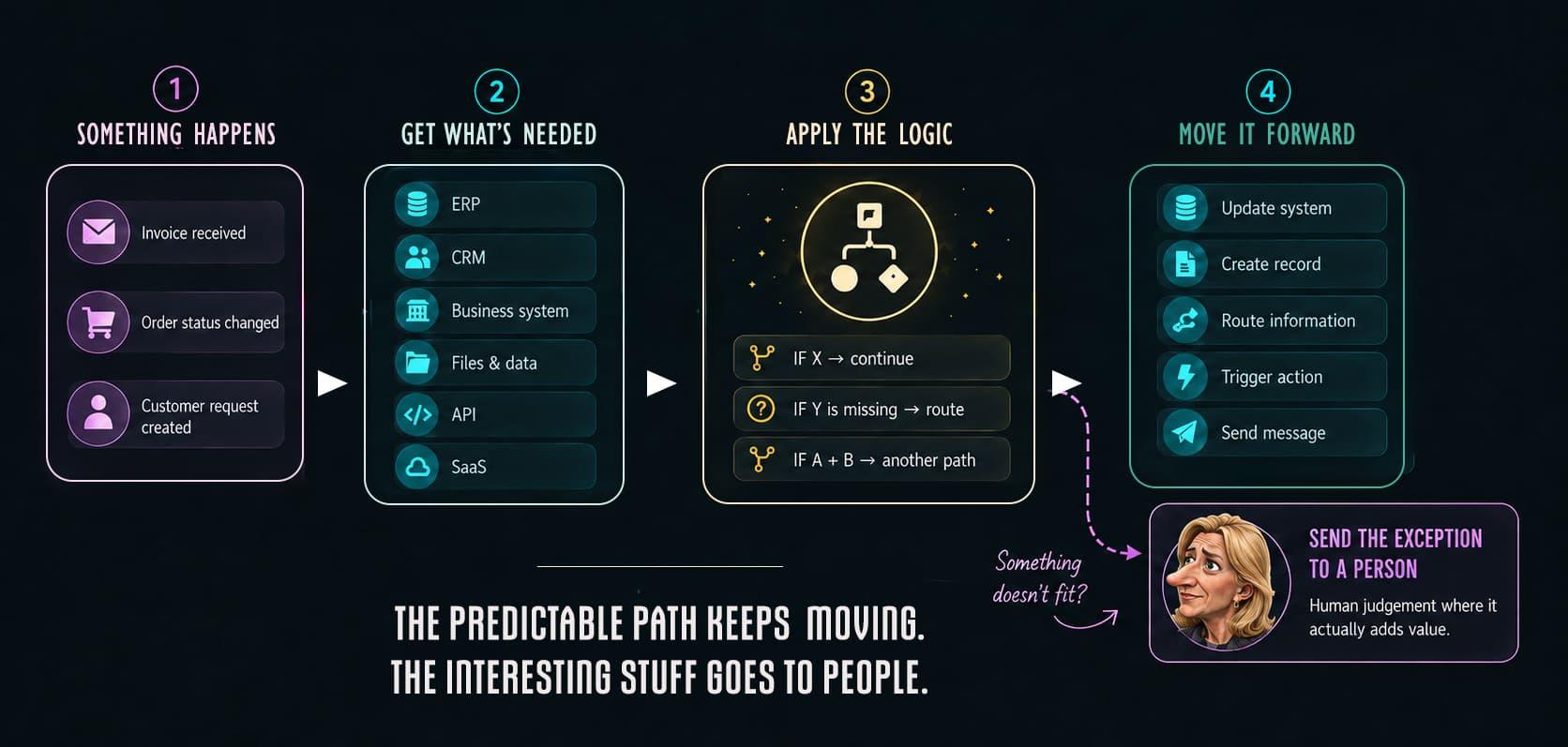
GET THE INFORMATION
A workflow can only act on the information it has.
Ghost Nodes can collect what the process needs from the systems and sources where that information already exists.
CRM. ERP. Business systems. Databases. APIs. Files. SaaS services.
Information can be combined, transformed and prepared before the next step begins.
So no one needs to open four applications just to assemble one answer.
APPLY THE LOGIC
Once the information is there, the workflow can decide what happens next.
Ghost applies the business rules that define the process.
If X is true → take this path.
If Y is missing → send it there.
If A and B match → perform another action.
If something falls outside the rules → treat it as an exception.
The logic can be simple or complex.
The important part is that predictable decisions no longer need to be made manually, one transaction at a time.
The predictable part becomes predictable on purpose.
.
MOVE IT FORWARD — OR HANDLE THE EXCEPTION
Once the decision is made, Ghost can continue the process.
Update another system.
Route information.
Create or change a record.
Trigger an action.
Send a message.
Wait for a response.
Retry when something is temporarily unavailable.
And when something genuinely requires judgement, the workflow can hand that specific exception to a person.
The predictable part doesn’t.
AUTOMATING WORK ACROSS SYSTEMS
Real workflows rarely live neatly inside one application.
One system may run locally.
Another in a datacenter.
Another in the cloud.
A fourth may be SaaS.
Some information may still arrive as files or come directly from a database or API.
That does not need to become the user’s problem.
Ghost Nodes can orchestrate the workflow across those environments, allowing information to be collected, validated, transformed, routed and acted on wherever the relevant systems happen to run.
No need to replace working applications simply to automate the process around them.
Not by rebuilding everything.
By automating what happens between it.
WORKFLOW AUTOMATION IN REAL LIFE
Together with Ghost Nodes, Advania Sverige AB has improved how invoices involving subprojects are handled in its financial workflows.
Using integration and validation logic, invoices are checked against defined rules before they reach the ERP system — reducing manual handling further downstream.
After seven months:
- 170,000+ invoices validated
- Less manual work
- Better control over a business-critical process
Small, targeted improvements.
Measurable operational impact.
LET PEOPLE DO THE WORK THAT NEEDS PEOPLE
And let the systems handle the rest.
Most organizations already have the systems.
They already have the information.
And in most cases, they already know the rules.
What is often missing is a way to make all of it work together without people manually holding the process together.
Ghost Nodes turns repetitive, rule-driven work into connected, automated workflows — across the infrastructure you already have.
Let the systems handle the predictable work.
Save the people for everything that isn’t.
Let’s talk about workflow Automation